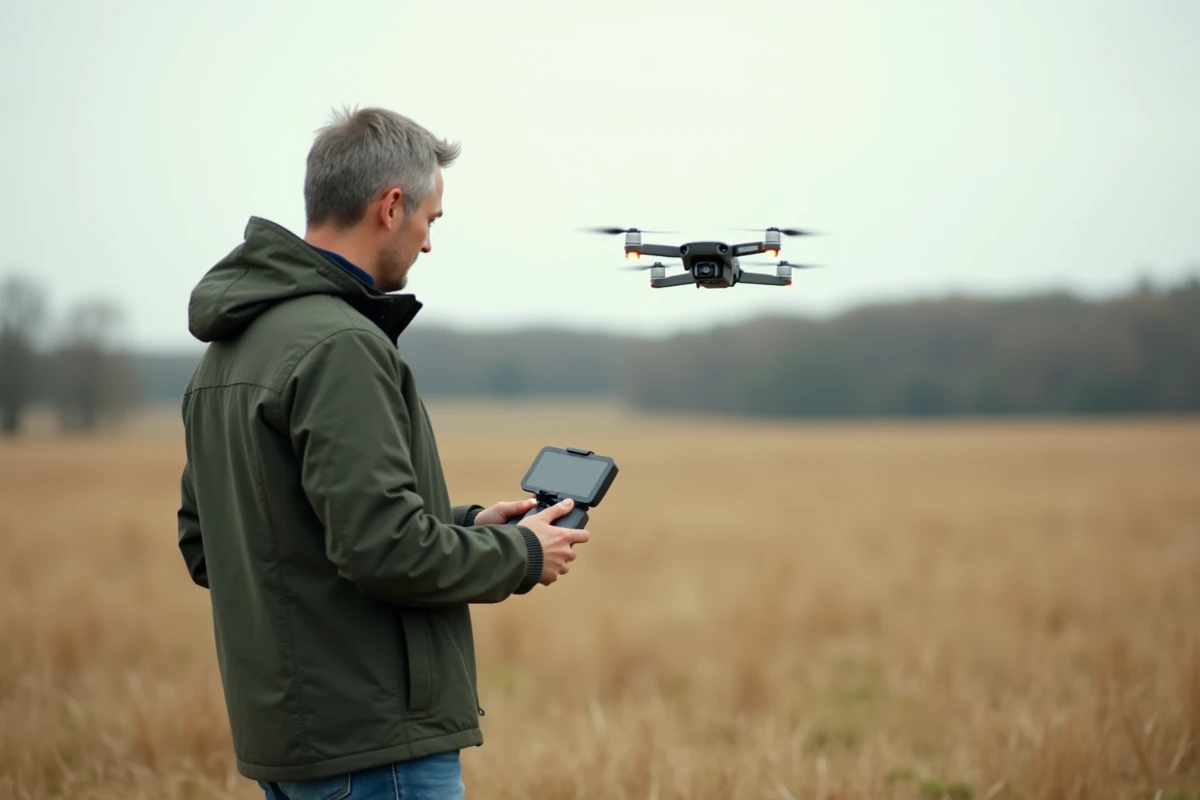
You have just purchased a drone or are considering doing so. Before the first takeoff, French regulations require several preliminary steps, sometimes unknown. The legal framework is based on European and national texts that classify drones by risk level, not just by weight or price.
Remote electronic identification: the new obligation that changes the game
Since the end of 2023, the DGAC has been preparing to extend the obligation of remote electronic identification (Remote ID) to recreational drones weighing more than 250 g. General enforcement is announced for 2026 as part of the French update of Regulation (EU) 2019/947.
Specifically, your drone will need to continuously emit a radio signal containing its registration number, its position, and that of the remote pilot. This signal will be readable by law enforcement equipped with appropriate receivers.
Why does this evolution matter for a recreational pilot? Because it transforms an anonymous flight into a traceable one. A drone without an activated Remote ID will be in violation, even in an authorized flight zone. To fully understand drone legislation in France, this future obligation should be anticipated now when purchasing a device.

Open category: subcategories A1, A2, and A3 explained simply
The European regulation classifies low-risk operations in the open category. This category is divided into three subcategories, and this is where most recreational pilots get confused.
Subcategory A1: flying near people
This concerns the lightest drones, marked as class C0 or C1. A C0 drone does not exceed 250 g and can fly over people not involved in the flight, without mandatory training. For a C1 drone, the remote pilot must have passed an online theoretical exam on the DGAC website.
Subcategory A2: flying at reduced horizontal distance
This allows class C2 drones to fly near populated areas, but never over people. The pilot must hold the theoretical certificate and have completed practical self-training. The minimum distance from people depends on the chosen flight mode (low speed or not).
Subcategory A3: flying far from populated areas
This is the subcategory that includes C2, C3, and C4 drones, as well as devices without CE marking sold before the implementation of the European system. The flight must take place far from any residential, commercial, or industrial area.
- In A1 with a C0 drone: no training required, but reading the current rules remains mandatory.
- In A1 with a C1 drone or in A3: free online theoretical exam on the DGAC portal (Fox AlphaTango).
- In A2: theoretical certificate plus documented self-practice, then additional exam.
Drone registration and UAS operator number: two distinct procedures
Many beginners confuse the registration of the device with obtaining the operator number. These are two separate procedures on the DGAC’s AlphaTango portal.
The UAS operator number is mandatory for any pilot, regardless of the weight of the drone (including under 250 g if equipped with a camera). You receive it after registering online. It must be affixed to each drone you own.
The individual registration of the drone, on the other hand, concerns devices exceeding a certain weight threshold. It generates a distinct number, linked to the device and not the pilot. This distinction has a practical impact: if you lend your drone, the borrower must have their own operator number.

Flight zones and restrictions: read the map before taking off
France divides its airspace into zones with varying restrictions. The official map, accessible on Géoportail, displays prohibited, regulated, and dangerous zones.
Here are the most common cases where flying is prohibited without specific authorization:
- Near airports and airfields, within a variable radius depending on the facility.
- Above sensitive sites: nuclear power plants, prisons, military grounds, hospitals.
- In national parks and certain nature reserves, unless a prefectural exemption is granted.
- Above gatherings of people in open air (markets, concerts, sporting events).
The maximum flight height in the open category is set at 120 meters above ground level. Some areas lower this ceiling, sometimes to just a few dozen meters. Checking the map before each flight is not a suggestion, it’s a legal obligation.
CATS: the future common European theoretical certificate
EASA and the European Commission announced in 2024 the project to replace the old national references for theoretical certificates with CATS (Competency-based Theoretical Standard) by 2026. This certificate will become the single basis for European remote pilots, including in France, for operations exceeding the simple open category.
For a recreational pilot flying exclusively in the open category, CATS will not change much in the short term. The free online certificate from the DGAC will remain valid for subcategories A1 and A3. However, if you are considering professional missions or flights in a specific category, keeping track of CATS developments will save you from retaking redundant exams.
The regulatory framework for drones is evolving rapidly, with two major deadlines in 2026: the widespread Remote ID and the transition to CATS. Flying legally today also means choosing a device compatible with tomorrow’s standards by checking its CE class marking and remote identification capabilities.